
When to Use a Wearable Breast Pump
If you’re pregnant or recently gave birth, you’ve likely made it to that motherhood milestone of choosing a breast pump. If you’re a first-time mom, this decision has probably been coupled with hours of research and asking other moms what worked for them. But as you’ve probably realized, there is no right or wrong breast pump because each woman’s breastfeed journey is unique.
Wearable breast pumps have recently grown in popularity on social media and appear all over the internet as a desirable breast pump option. As a lactation consultant, using a wearable breast pump often comes up when assisting moms with selecting a breast pump. The most effective way to gage if a wearable breast pump is the right option for them is to understand their pumping journey goals.
The best way to decide if a wearable breast pump is right for you is to ask an expert! This blog will break down how to decide if using a wearable breast pump fits your personal needs and lifestyle.
What is a Wearable Breast Pump
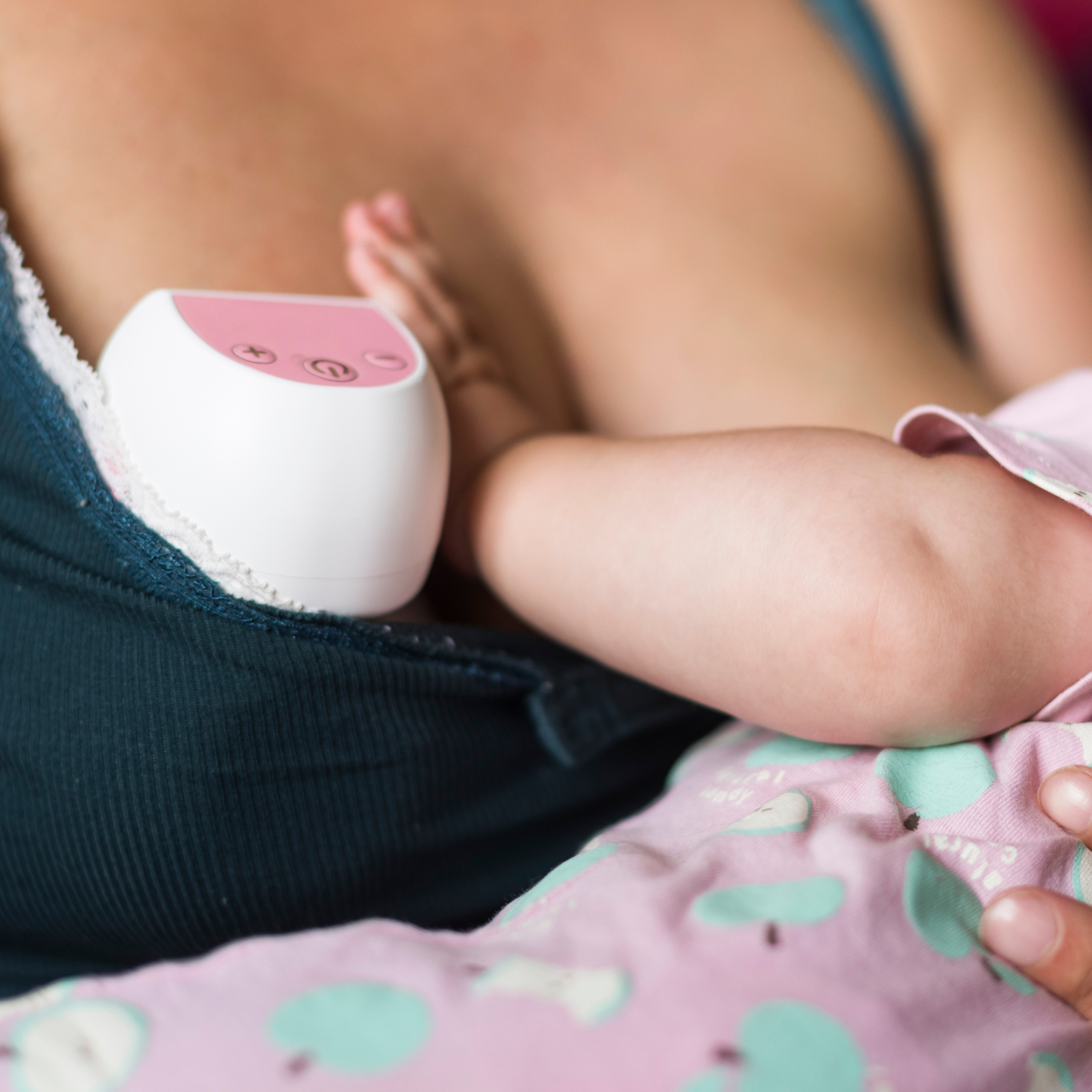
Wearable breast pumps are designed for hands-free use and are often discreet and portable. These pumps fit into your bra, allowing you to pump while you move around. They have a cup-shaped design that contains the motor and the milk collection portion. Wearable breast pumps are battery operated and do not have visible tubes or cords.
Some popular wearable breast pump options include the Zomee Fit, Motif Aura Glow, and Momcozy S12.
A standard electric breast pump typically includes tubing, which can be bulky, and some require to be plugged in to the wall while using. Wearable breast pumps feature the unique design of having smaller motors at the top of the collection cups.
What are the Advantages of Using a Wearable Breast Pump
Mobility
Most moms are interested in a wearable breast pump because of the freedom they provide. Being able to freely walk around and be able to accomplish just about anything you could be doing if you weren’t pumping is the number one reason moms are drawn to a wearable breast pump design.
Sticking to a Schedule
Another huge advantage of a wearable breast pump is that it can make it easier to stick to a pumping schedule. Sometimes life gets in the way, and you do not have time to make it to the pumping room or sit down in your favorite chair at home for a pumping session. Whether it’s in the carpool pickup line, during household tasks, or while eating, a wearable breast pump can give you the peace of mind that you can better stick to a pumping schedule.
Discretion
Wearable pumps provide the ability to pump just about anywhere with discretion. Being able to slip it directly into your bra and continue with your day can be an advantage depending on your lifestyle.
Noise Level
Wearable breast pumps tend to be significantly quieter while in use compared to a plug-in breast pump option.
Easy to Clean
Because a wearable breast pump typically features less parts than other electric options, it is easier for moms to clean and store.
Portability
Wearable breast pumps are small enough to fit in a bag, ideal for moms who are frequently on the go.
Battery Powered
Wearable breast pumps are battery-powered, meaning that you do not have to worry about being close to an outlet to use. Again, grab, go, and pump wherever the day takes you.
What are the Disadvantages of Using a Wearable Breast Pump
Price
Wearable breast pumps typically feature a higher price point than standard electric breast pumps, and some may not be fully covered by insurance.
Comfort
No matter your pumping frequency, comfort is huge when deciding on a breast pump. A major factor in comfort is finding the right flange size. Painful pumping is not normal and could potentially stem from poor flange fit. When using a standard breast pump, you are able to see how the flange fits relative to your nipple. The flange tunnel on a wearable covered by the motor, so it makes it difficult to visually see if the flange has a correct fit.
A great way to measure your correct flange size is to meet with a lactation consultant, even during pregnancy. For more information, read our blog about correct flange sizing and get a head start with our free downloadable nipple ruler.
Limited Setting Options
Most wearable breast pumps offer limited or no customization of cycle speeds. Typically, the number of cycles per minute is directly tied to the suction level—meaning that increasing suction often results in a slower cycle speed. As a result, mothers may find it difficult to adjust the settings to match their personal comfort or preferences.
Transfer of Milk
Wearable breast pumps are designed to express milk directly into built-in collection cups. This means you'll need to transfer the milk into bottles or storage bags afterward. Be sure to pack a container or storage option for the collected milk when you're on the go.
Possible Leaking
Watch out for leaking! Most wearable breast pumps designs are not leak-proof. Leaning forward while pumping can cause milk to spill, making it less practical for certain chores or physical activities. Additionally, the cups may tip and leak during storage and overfilling them when pumping can also lead to spills.
Charging
With battery powered breast pump comes charging. If your pump is not charged, you cannot use it! You must stay on top of keeping your pump charged and packing the charger with you on your travels.
Possible Less Milk Output
Some moms might experience less milk output when using a wearable breast pump. The portable design means that mothers are often multitasking and not always relaxed when pumping, which may inhibit “let down” and overall result in a less efficient pumping session.
What are the Advantages of Wearable Breast Pumps for Working Moms
Discretion and mobility are key factors for many working moms when choosing a breast pump. The portability of a wearable breast pump makes it an excellent option for those who value privacy and flexibility upon returning to work. Its compact design allows for more discreet pumping, even in crowded office spaces or shared cubicles.
What are the Disadvantages of Wearable Breast Pumps for Working Moms
Moms who exclusively pump may struggle to fully empty their breasts when using a wearable breast pump, which can affect milk supply over time. Working moms will also have to ensure their pump is charged, remember to bring their charger, and pack collection bottles or bags to store milk.
What are the Advantages of Wearable Breast Pumps for New Moms
New moms who are adjusting to life with a newborn might find it easier to use a wearable breast pump to complete their pumping goals. They are able to attend to their newborn, older children, or household chores more efficiently than a plug-in breast pump.
What are the Disadvantages of Wearable Breast Pumps for New Moms
Limited visibility of the nipple and collection cups can make it harder for new moms to identify potential issues when using a wearable breast pump. If the breasts aren’t emptied effectively, it may lead to complications such as reduced milk supply and clogged ducts.
When to Use a Wearable Breast Pump
When deciding on which breast pump is right for you, ask yourself the following questions:
What are your breastfeeding goals?
What is your feeding plan?
Are you going to be away from your baby on a regular basis (work or school)?
How much time do you have to spend pumping?
What location do you see yourself pumping most?
Is your baby feeding well at the breast?
Answering these questions can help point you in the direction of the breast pump that will best serve your needs and lifestyle.
Choosing the right breast pump during pregnancy can be tricky because breastfeeding has not yet been established, and there are still so many unknowns. If using your insurance benefit to obtain a breast pump prior to delivery, I generally recommend making sure you have access to a good primary breast pump before opting for a wearable breast pump. Once a mom has a consistent and successful pumping routine, incorporating a wearable pump can offer added flexibility for busy days or on-the-go pumping. I also recommend a primary tabletop breast pump for exclusively pumping mamas, because these can endure pumping 8+ times a day and are efficient at emptying the breast.
Not sure what your pumping journey will look like? Meeting with a lactation consultant can give you a better idea of a day in the life of a mom with a newborn which can be immensely helpful for first-time moms and give you a better idea of what breast pump would best fit your lifestyle.
Which Mom are You?
The three types of moms below are going to be matched with what breast pump I, as an IBCLC, would recommend.
Mom A:
Mom A is a first-time mom. She plans on going back to work after her maternity leave, but her feeding plan still involves breastmilk. She knows to accomplish this, she will have to pump frequently. Her office has a mother’s room that provides privacy, which will be the location she most often pumps at.
My IBCLC Recommendation:
Mom A will likely be pumping regularly 3-4 times a day 5 days a week, due to her work schedule. To keep up with this demand, her breast pump will become her best friend. I would recommend a primary tabletop breast pump, such as a Spectra S2, Cimilre S6+, or Motif Luna. These pumps are reliable even under frequent use and efficient at expressing milk, which helps maintain milk supply.
Mom B:
Mom B is a stay-at-home-mom, pregnant with her second baby. She breastfed her first baby until 18 months, so she is very familiar with the demands that come with breastfeeding. She is prepared to do the same with her second baby but is using insurance to receive a breast pump. Mom B plans to use this breast pump to build a small freezer supply she can use on the occasion someone else needs to feed her baby. Her day usually consists of running errands and trying to keep up with her toddler.
My IBCLC Recommendation:
A wearable pump could be a great fit for Mom B, especially if her baby latches and feeds well at the breast. It offers a convenient solution for those occasional moments she's away from her baby and allows her to build a small freezer stash. However, it’s important to remember that every baby is different, and it's impossible to predict how breastfeeding will go with her second child until they arrive.
Mom C:
Mom C is a first-time mom who is doing her due diligence by ordering a breast pump through her insurance. She isn’t sure of her feeding goals but definitely wants to try breastfeeding. Her mom thinks she needs a tabletop breast pump, but Mom C’s friends use wearable breast pumps. She plans on going back to work part-time from home and will have in-home childcare while she is working.
My IBCLC Recommendation:
Mom C’s routine will likely involve combination feeding, with her baby receiving both bottles and direct breastfeeding during the workday. This mama has options! If her baby is feeding well at the breast, a wearable breast pump could be a convenient choice for occasional use. Alternatively, a tabletop or portable pump would also be a reliable option. Each offers different levels of convenience and flexibility depending on her schedule.
Which mom matches your lifestyle most closely? Or is your situation completely different? If so, meeting with a lactation consultant can be extremely helpful in your feeding journey.
Wearable Breast Pumps Recap
A wearable breast pump is convenient and freeing, but not always the only solution. Moms can make an informed choice about what works best for their lifestyle and supply needs. Maternal by Sentido supports moms with education, guidance, and access to the right breast pump. Ready to see if a wearable breast pump is covered by your insurance? Let Maternal by Sentido supply your breast pump and be the lactation consultants to support your journey.
Can I get a Wearable Breast Pump with Insurance?
Thanks to the Affordable Care Act (ACA), insurance plans are required to cover the cost of a breast pump. Each insurance plan has different guidelines, coverage options, and benefits, so it is important to contact your insurance company and see what you will be your plan covers. Some things that may vary between insurance companies are…
The type of breast pump and whether it is fully or partially covered.
What else is provided along with the breast pump, some plans include lactation support, classes, milk storage bags, and additional pump parts.
When you can order a breast pump?
How often can you get a new breast pump?
Why Should I Use Maternal by Sentido?
At Maternal by Sentido, we offer breast pumps through insurance with little to no cost out of pocket. After submitting the insurance eligibility form, we will quickly respond with the breast pump options your insurance covers. If you are not sure which breast pump is right for you, our experts will take the time to discuss your options and help you choose from one of our top-quality breast pumps.
After you place your order, your breast pump will be shipped directly to your home with no shipping cost.
After your breast pump order is submitted, you immediately qualify for complimentary lactation support whenever you need. Our certified Lactation Consultations will work with you directly to ensure a successful breastfeeding or pumping journey.

Connect with Maternal by Sentido
Our team is dedicated to providing the highest quality breast pumps through insurance and getting to know you as a mom and guiding you through your maternal health journey.
Maternal by Sentido has an online community offering informative blogs, downloadable material, and social media that will carry you through your maternal health journey.
Instagram | Facebook | Blog | Downloadable Material

A Message from the Author:
Hi! I’m Tara. I am a wife, a mother of two energetic children, a registered dietitian, and a lactation consultant. As a lactation consultant, I specialize in helping mothers and babies navigate feeding and growth challenges. My mission is to foster a successful mother-baby dyad, understanding that every journey is beautifully unique. I am deeply committed to empowering mothers with the guidance, tools, and encouragement they need to thrive in their breastfeeding and parenting goals.
About the Author:
Meet Tara! Tara earned a Bachelor of Science in Human Food and Nutrition with a minor in Business Administration from the University of Houston, followed by a Master of Science in Nutrition from Texas Woman’s University. With over 17 years of experience in clinical nutrition, Tara has had the privilege of working with both adults and children. For the past six years, she has focused her expertise on pediatric nutrition at Texas Children’s Hospital in Houston, Texas, where she discovered her deep passion for supporting growing families. During this time, Tara earned her certification as a Certified Lactation Counselor (CLC) and later achieved the prestigious International Board Certified Lactation Consultant (IBCLC) credential. She accomplished this after completing over 1,000 hours of lactation-specific education and hands-on experience.